In the GDR, one aim of school policy was to introduce students to science as early as possible. Curriculum reforms between 1965 and 1972 were intended to make subject teaching even more scientific and socialist in nature. From a dialectical-materialist perspective, scientific rigour and partisanship were related to each other in such a way that the Marxist-Leninist (→ Marxism-Leninism) world view was simultaneously defined as correct, true, objective, and therefore scientific. Conversely, science had to operate within this political value structure.
Scientific rigour and partisanship
'Scientific rigour' played a central role in the GDR and the narrative of the 'scientific-technical revolution' (Wissenschaftlich-technische Revolution) was also interpreted as a pedagogical task. As part of polytechnical education (Polytechnischer Unterricht, → polytechnical education; Polytechnische Oberschule, → polytechnical secondary school) and against the backdrop of the Cold War, education in the technical and natural sciences was therefore particularly favoured. In the pursuit of technical progress and economic rationality, children and young people were to be prepared for their active role as working citizens. From the outset, lessons were to be based on scientific principles in terms of both didactics and content. In order to show that the content was geared towards the respective subject, scientific educational films used factual imagery and relevant technical terminology. However, scientific rigour was not limited to a scientific orientation, but also referred to Marxism-Leninism as the 'scientific world view' of socialism. In the understanding of the GDR, 'scientific rigour' and 'partisanship' were an inseparable pair. In the same way, the formation of the 'socialist personality' presupposed that knowledge and attitudes were linked (→ comprehensively developed socialist personality). The narrative of the 'scientific-technical revolution', which had been an important point of reference for the self-image and self-assertion of the natural sciences in the GDR since the 1960s, thematised a claim of modernity that can also be understood as scientification (Verwissenschaftlichung).
In 1970, the article "Scientific-technical Revolution and Educational Reform in the German Democratic Republic (GDR)" by Gerhart Neuner1 was published in the "International Journal of Educational Science". Neuner's article is aimed at an international – i. e. also Western – readership in education science and explains the development of the GDR education system (Volksbildungswesen; → the people's education system):
"The future belongs to that social order, which is capable of producing the greater intellectual potential, a maximum of education, that educational development which is necessary for mastering the problems and tasks of scientific and technological development for the benefit of mankind in the last third of our century." (Neuner, 1970, p. 291)
In the GDR’s self-image, 'technical superiority' was part of the GDR's position as a 'leading scientific power', another narrative that emphasised exceptional efficiency of the national economy and justified the relevance of scientific knowledge. In this sense, curriculum reforms between 1965 and 1972 also aimed to orientate teaching towards scientific knowledge, which was always coupled with references to applications in everyday teaching practice.
Audio-visual media
Audio-visual media2 such as educational films were regarded in the GDR as particularly effective instruments for conveying ideological attitudes; it was believed that they could be used to convincingly combine 'scientific rigour' with 'partisanship'. It was in this spirit that Ewald Topp3 appealed to teachers:
"His [the teachers] task is to make clear to them [the pupils] the connection between ideology and technology and thus the role of technology in the class struggle. The teacher should be able to demonstrate convincingly that technology is an instrument in the hands of mankind to achieve ever better control of nature. [...] It is important that the teacher recognises how necessary this technology is in order to make the pedagogical process more rational and effective, and that teaching can no longer be technology-free in the future." (Topp 1973, p. 89)
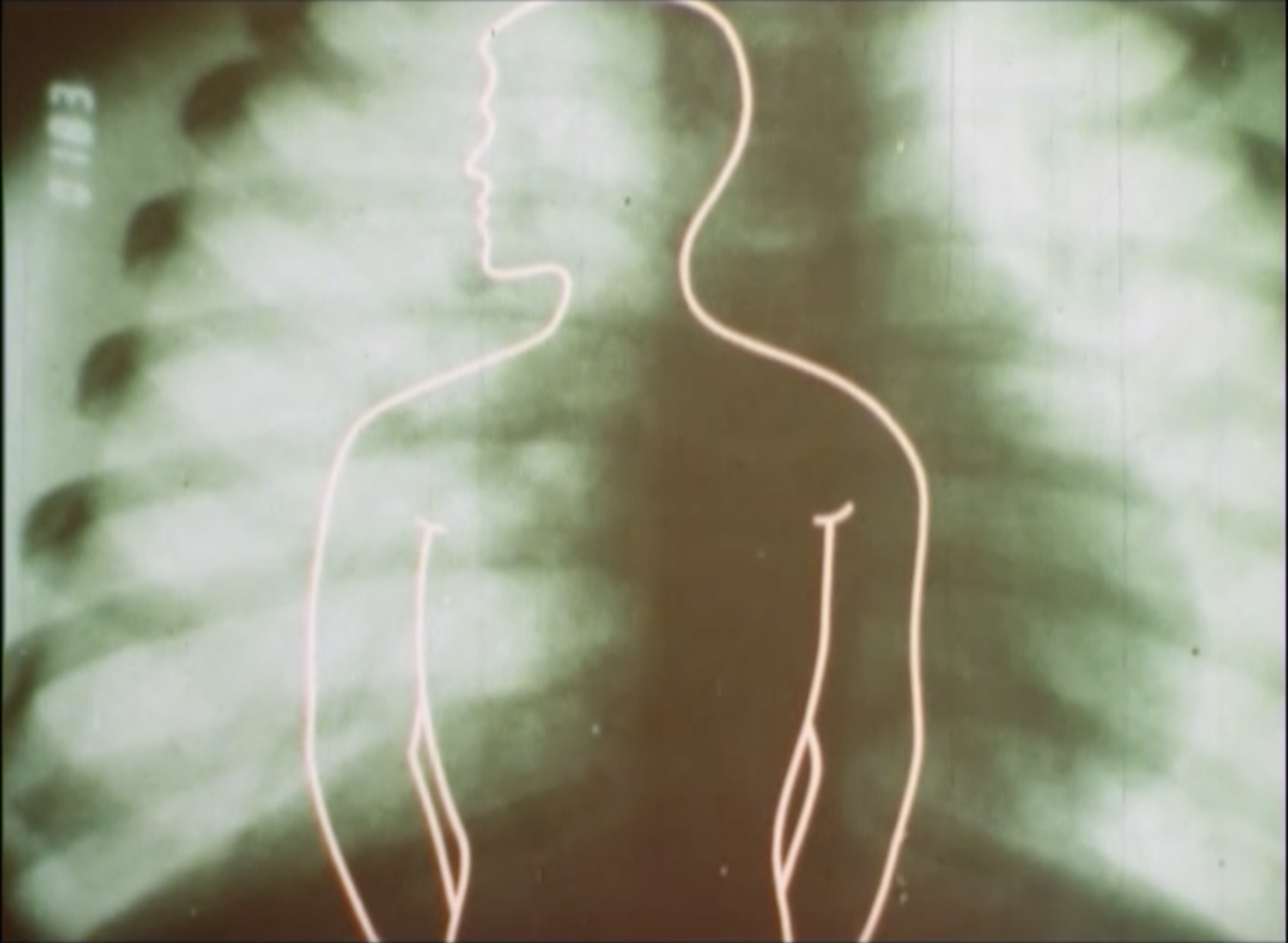
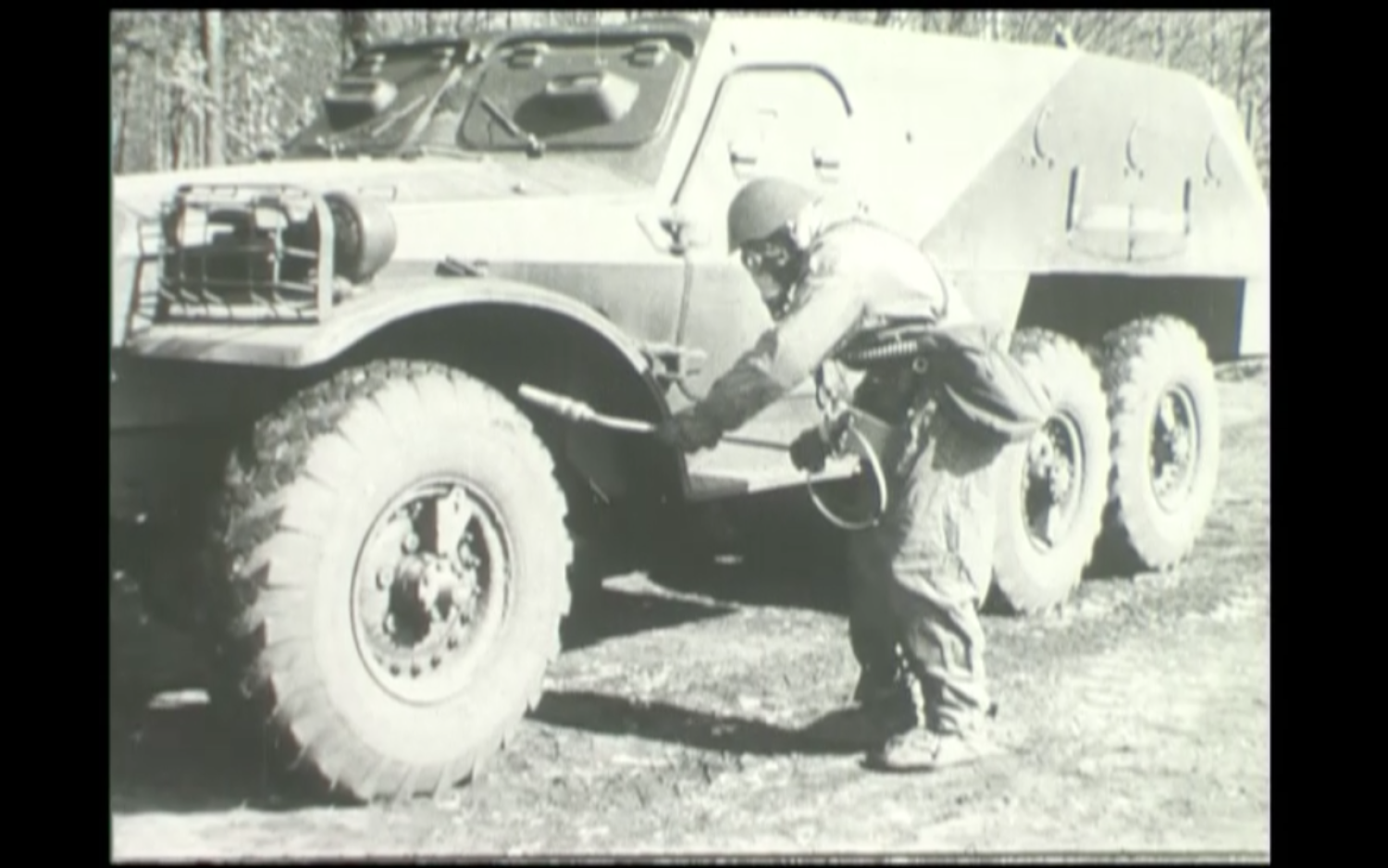
In educational films, scientific settings such as laboratories or experimental set-ups as well as abstract sign systems (such as diagrams, circuit diagrams, schematic and model representations, but also formulae and icons) point to a 'scientific rigour'. White writing on a black background invoked a visual pattern that referred to the writing on a blackboard common in academic and teaching contexts at the time. The 'scientific nature' of the educational content was emphasised by the montage of scientific images such as X-ray or microscope images. Documentary film footage of, for example, industrial companies was used to portray professional actors as 'labourers'. These cinematic strategies – documentary style, scientific graphics, etc. – created the impression of a specific (scientific) 'factuality'. In sound films, the factual voice-over commentary using scientific terminology also acoustically emphasises the scientific nature of what is shown. If animations were used, the image of a science following causal principles was conveyed, which acted logically, but whose imagery presupposed a level of information – such as modelling skills – without which the viewer could not understand what was being shown. Fundamentally, an authority of scientific rigour was constructed in the films, which invoked scientific methods in experimentation, notation, and terminology and thus claimed scientific objectivity.
The more complex films in particular incorporated application scenarios that can be understood as formulaic and interpretative variants of the overarching narrative of the scientific-technical revolution. By way of visual application references and ideological commentaries, the technical content of the teaching was implemented in the socialist value system (→ ideology). The school knowledge to be imparted was thus bound in space and time – and at the same time legitimised as socially relevant. In comparison to the classroom, the course of educational films was predetermined from the outset, and in principle endeavoured to be unambiguous. However, the effect of educational films was primarily controlled by the teacher: due to its brevity, the teacher had to integrate it into lessons, introduce the film, comment on it (especially if the film was silent) and follow it up. Government-commissioned pedagogical research studies on the use of educational films indicated that the more heavily narrated films were less popular with subject teachers, citing didactic considerations, whereas films that focused on a specific thematic element were seen as more suitable didactic tools. These focused films were also designed as 'objective' representations and thus conveyed a specific image of modern science, albeit one that could not be read as socialist in the strictest sense.

Research on the effects of educational media in the GDR emphasised the emotional impact of film in general and pointed to educational film’s particular suitability for ideological education (→ ideology). In the materialist view of education, the realm of emotions was closely linked to that of physical reaction and so, especially in the 1960s, sprinkles of Pavlovian reflex theory (→ pedagogical psychology) found their way into theoretical considerations of educational films. They were thus discussed as a means of conditioning. With cybernetic approaches, which were also discussed in the GDR in the 1970s with regard to the technical equipment of schools, the idea of cinematic control was categorised in the functional context of information science programming of teaching. After rather unsatisfactory results in experimental studies, television (or video recording) was seen as a new beacon of hope in the 1980s. Nevertheless, GDR pedagogy fundamentally emphasised the central role of the teacher for success of lessons, as only the teacher was seen as being able to employ technical aids adequately.
-
[1]
Neuner (a trained chemistry and biology teacher), after completing his doctorate and habilitation in Leningrad, was the first director of the APW from 1970 and was therefore directly involved in the management of the GDR education system.
-
[2]
In general, the term media (Medien) was not used in the educational texts of the GDR. The term "teaching aids" (Unterrichtsmittel) was used in reference to schools and "teaching-learning aids" (Lehr-Lernmittel) for universities. Films, slides, audio tapes, and projection films were referred to as audio-visual media. Television programmes played a special role.
-
[3]
From 1964 to 1968, Ewald Topp was head of the teaching aids section at the German Central Pedagogical Institute (Deutsches Pädagogisches Zentralinstitut, DPZI) and was appointed deputy head of the Institute for Teaching Aids (Institut für Unterrichtsmittel) at the APW in 1971. In his dissertation, part of which was published in 1973, Topp examined the use of technical teaching aids from the perspective of educational economics and lesson organisation. Instructional films were part of the subject-specific teaching materials and belonged to the basic technical equipment (technische Grundausstattung) of the school.
-
Neuner, G. (1970): Wissenschaftlich-technische Revolution und Bildungsreform in der Deutschen Demokratischen Republik (DDR). In: Internationale Zeitschrift für Erziehungswissenschaft, 16, 3, S. 286–297.
-
Topp, E. (1973): Zur Funktion, Nutzung und Weiterentwicklung der technischen Grundausstattung der Oberschulen der DDR. Berlin: Volk und Wissen.
The film combines documentary images, studio shots...

Supplementary booklet to the educational film written by D. Neupert...

The film is about four and a half minutes long and was...

One of two educational films about the...

A central myth within the GDR's socialist conceptions of society was the realisation of an 'education for all' (Bildung für Alle).

The narrative of gender equality was an important element of the state’s self-image in the GDR and the promises of socialism.

The myth of a so-called antifascist founding was part of the GDR's self-image in its use as a system-reinforcing narrative.

Groups such as the class at school or the Young Pioneers (Junge Pioniere) and the FDJ (Freie Deutsche Jugend) played an important role in the GDR as 'collectives'.

Children in the GDR were educated by way of becoming socialist personalities. How do contemporary witnesses describe their GDR childhoods?
