As part of a research case study on childhood memories (→ memory), contemporary witness interviews between children of today and older people from the former GDR were analysed. The questions asked in these interviews were developed by the children themselves; the focus of the analysis was on the stories told by the witnesses. Overall, the results of the study show that the witnesses approached the interviews with different intentions and seemed to deliberately share specific accounts. In their stories about their own childhood, they repeatedly differentiate them from today's childhoods – for example with regard to living, leisure, travel, and school. In recounted memories they focus on their individual everyday lives as children. They describe childhood as a beautiful, free niche unobserved by adults. Within the framework of institutionalised care, political influence also took place in the GDR, but this hardly appears in the memories recounted. Instead, politically influenced organisations such as the GDR school or the youth organisation Young Pioneers (Junge Pioniere) (see also Sources in focus: Pioneer narratives) are depoliticised. In the following, the key take-away of the study, a remembrance of GDR childhoods as a depoliticised idyll, is expanded upon using transcript excerpts from the conversations.
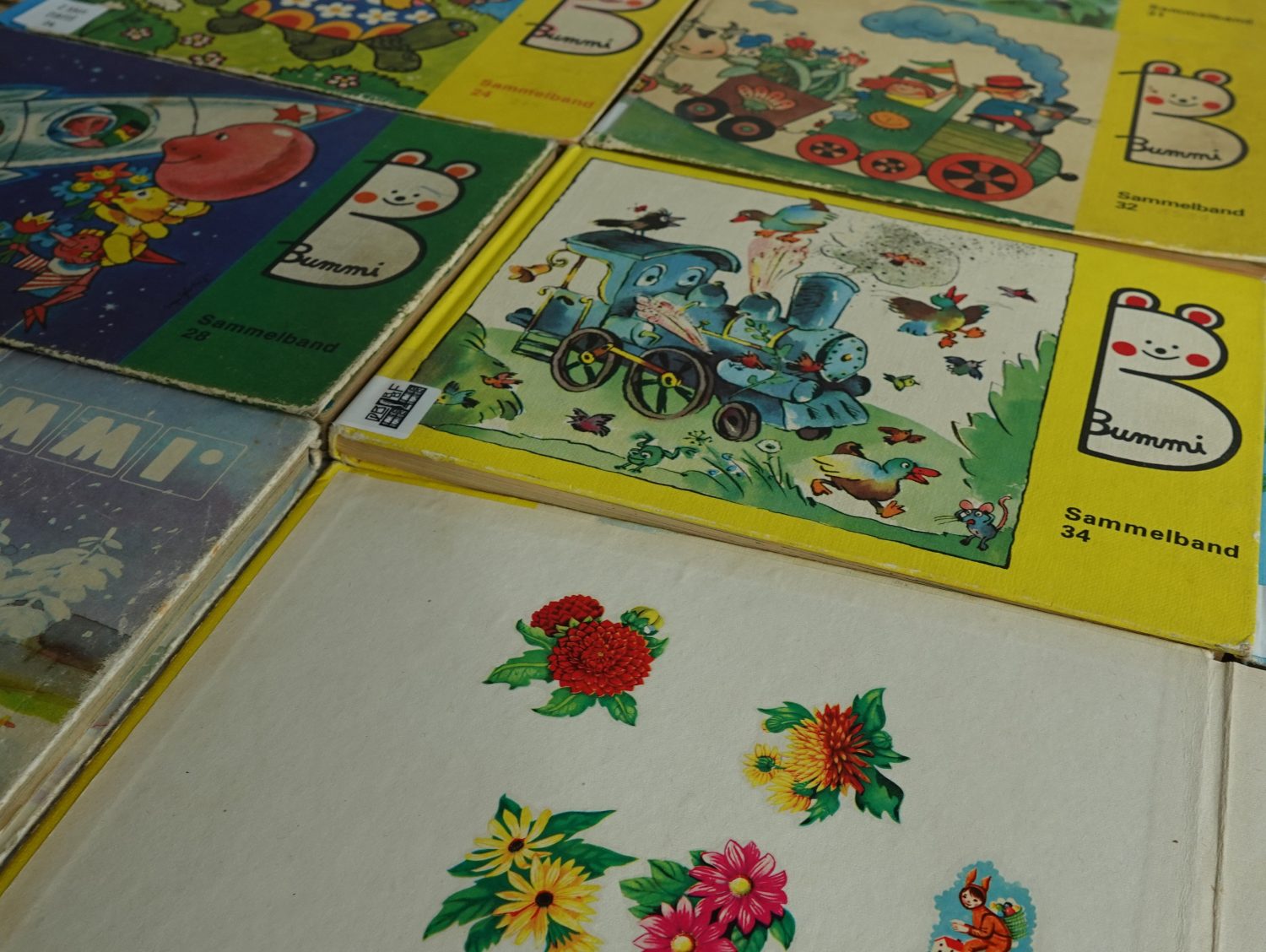
Childhood takes place outdoors
In the stories told by contemporary witnesses, their own childhood mainly took place outside and in groups. In most cases, the children were not supervised by adults, but instead spent their free time with their peers. Experiences with their parents were only occasionally discussed in the interviews. The unsupervised, free outdoor play is described by the contemporary witnesses as a carefree childhood idyll, for example by Mrs Beech1 (born 1958):
I.: "And I have another quick question. When you met up with friends. What did you do and were you allowed to go by yourself?"
Mrs B: "When I was little, when I was a child? Well, as I said, on the playground. Where I lived in the east of Leipzig, it used to be a working-class neighbourhood. We had courtyards there, backyards. We used to meet up there, like a little clique, and then we'd climb trees together or play hide-and-seek or we had a little park, like I said the playgrounds. Then we romped around in the meadow in the summer, no. In winter, we had to be at home more. It was all a bit easier back then than it is today, no."
The "we" signifying the group of children in the episode narrated here illustrates a sense of community. Mrs Beech also concludes with a comparison to the present: everything used to be a bit simpler. Playing took place at playgrounds, in backyards and in nature. In other interviews, vacant spaces are also repeatedly mentioned as spaces designated for play.
Mrs Maple (born 1965) also draws a comparison to the present. She discusses playing outdoors in the context of technical developments that have accelerated since her childhood.
Mrs M: "But you really didn't have any, you didn't have a cell phone like you do now. No computer, no laptop, no internet stuff, no phone. That's why you played outside a lot more. In the forest and skating or sledging or building your own huts from trees. No? Or in barns, well, here in the countryside you could let your imagination run wild. And that was actually fun. Or in friends' attics and stuff like that, right? And then we'd dress up in old shoes or curtains. That was really fun. So, you didn’t miss anything."
Like Mrs Beech, Mrs Maple ends in a concluding classification that can be interpreted as a comparison with the present: she didn't miss anything. This type of double negation appears again and again in the interviews. It can be interpreted to mean that the contemporary witnesses – without clearly stating it – are referencing a deficient image of life under dictatorship in their narratives. They describe their childhoods using various leisure activities and both Mrs Beech and Mrs Maple rely on describing and listing rather than re-telling concrete situations. In their interviews, the contemporary witnesses gave two reasons for playing outside: firstly, their parents worked and therefore had less time for their children. Secondly, the children played outside so much because living was confined and there simply was too little space to play indoors.
Personal images of childhood
Due to the special interview situation, the personal ideals of the contemporary witnesses for their individual childhoods become particularly clear. When evaluating current childhood, it is typically perceived and evaluated by adults against the background of their own childhood memories (e.g. Alexi, 2014; → memory). From a narrative perspective, one's own childhood is often described as particularly happy, while current childhoods tend to be perceived negatively. This can be seen, for example, in discourse on the so-called changed childhood in which changing conditions of growing up due to social change is problematised (ibid.). In contrast, there are large-scale studies such as the World Vision Children's Study (World Vision e.V., 2018) or the KIM Study (mpfs, 2023) ), which survey today's children about their childhood. In them, a much more differentiated picture emerges, for example, meeting friends and playing outside are still among the favourite leisure activities of children of primary school age.
In the interviews, the contemporary witnesses insinuate that childhood today is shaped by media and affluence. In contrast with their own experiences, the contemporary witnesses find parents today to be more controlling. Examples include Mrs Hornbeam (born 1968) and Mrs Datepalm (born 1965):
I.: "Okay. And which channels did you watch on TV?"
Mrs H: "Oh! We only had I think two channels. So there weren't as many as there are today, and also watching that much TV? I didn't as a child, there was always a fairy tale film on Saturday. [...] And in the evening, just before 7 pm, the Sandman (Sandmann) came on. And we didn't watch much else. So, we were out on the street a lot and played. Television. Television wasn't as much of an issue back then as it is now. We didn't have mobile phones or anything like that."
Mrs D: "Well, we didn't have mum and dad drive us somewhere like they do today, that just didn't exist back then, did it? Our parents worked a lot, worked long hours. We were also latchkey kids (Schlüsselkinder) sometimes, no?"
Mrs Hornbeam recounts that she only watched very little television. In this context, the subject of childhood taking place outside is raised again. Mrs Datepalm talks about the absence of her parents during her own childhood and contrasts this with the situation today. In both quotes, the older people differentiate themselves from today's children – their impressions of present-day childhoods become clear. They specifically bring these up in conversation and describe the different nature of their own childhoods according to them.
De-politicisation in the case of schooling
In the way schooling experiences are narrated, contemporary witnesses refer to school subjects, the premises and their teachers. A political influence, that could show up, for example, in particular lesson content in the subjects of local history or civics, is hardly ever mentioned in the interviews. Instead, the narrative focus is more on order and discipline, as can be seen in the following description by Mrs Hornbeam (born 1968):
I.: "And how were your lessons?"
Mrs H: "I don't think my lessons were much different to yours. The difference was that we had to stand behind the chair at the beginning of the lesson. And then the class representative (Klassenvertreter) checked that we were all standing still and quiet. And then he went to the teacher and announced that class was ready for its lesson, and she said: 'Sit down'. And only then were you allowed to sit in your chair. If you were quiet and calm. And then the lesson started."
In this excerpt, Mrs Hornbeam again compares memories of her own childhood and schooling experience with the present. She vividly describes organisational procedures before the start of lessons; the teacher is portrayed as an authority. It is striking that no reference is made to any political influence according to the GDR education ideal of the development of a socialist personality (→ comprehensively developed socialist personality).
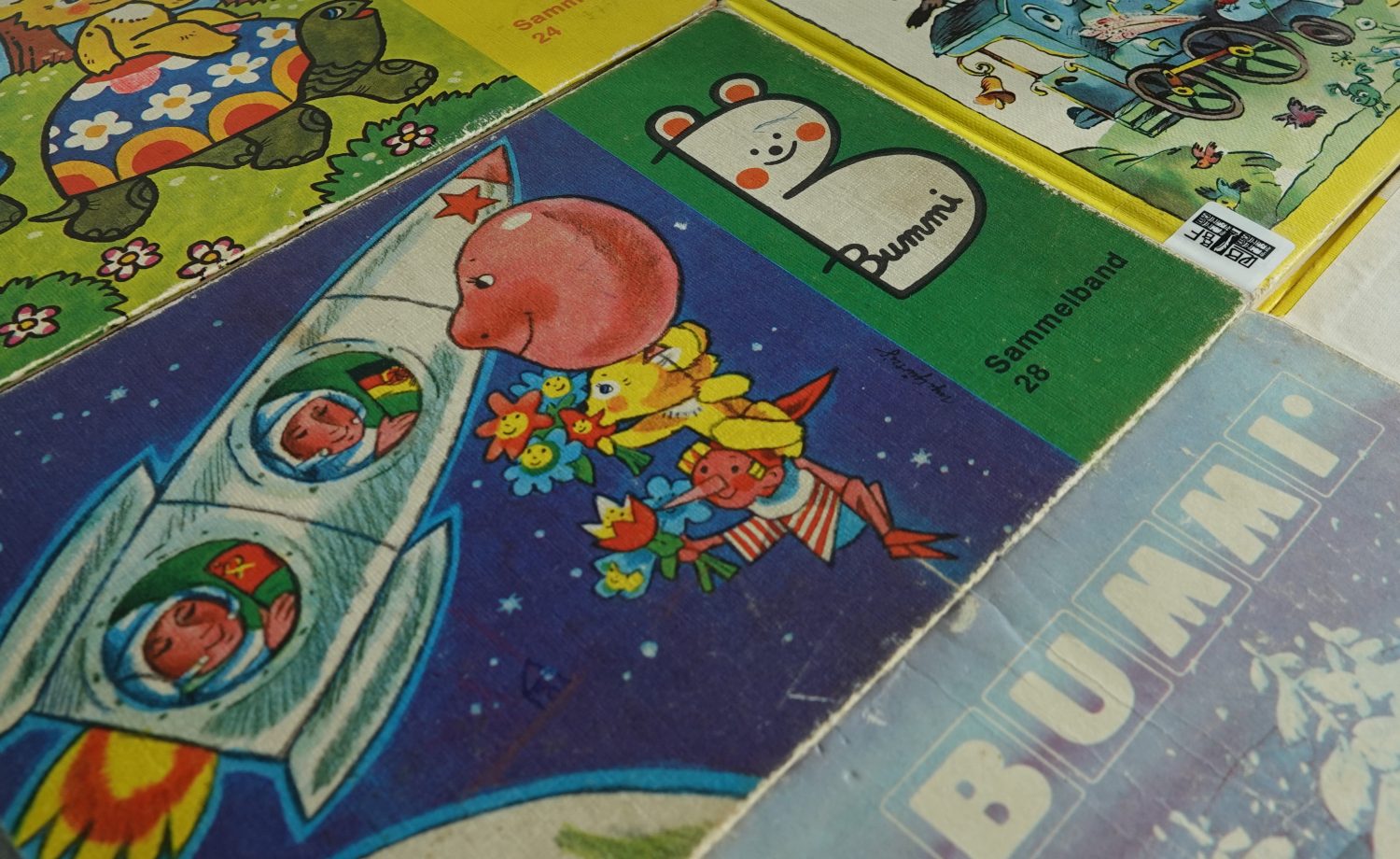
Various images of childhood can be reconstructed from these accounts of contemporary witnesses. In one of the interviews conducted, contemporary witness Mrs Alder sums up that her childhood was very carefree. This positive view of her own childhood, the image of an idyllic childhood, can be found in almost all the childhood memories recounted. These can thus be clearly assigned to arrangement memory (cf. Sabrow, 2009), i. e. the everyday historical dimension of memories (→ memory). References to political topics and politicisation can only be found in rare cases. By contrast, childhoods today tend to be viewed in a culturally pessimistic (kulturpessimistisch) way. Based on these findings, the question arises as to what extent the recounted childhood memories are specific to the GDR? Are the memories of a free childhood, which mainly took place outside, perhaps more due to generational differences? These questions will be addressed by examining childhood narratives from a West German perspective in the second phase of the project.
-
[1]
All names are pseudonyms. The interviews were conducted and transcribed in German and later translated into English.
-
Alexi, S. (2014): Kindheitsvorstellungen und generationale Ordnung. Leverkusen: Budrich.
-
Medienpädagogischer Forschungsverbund Südwest (mpfs) (Hrsg.) (2023): KIM-Studie 2022. Kindheit, Internet, Medien. Basisuntersuchung zum Medienumgang 6- bis 13-jähriger in Deutschland. (Abruf 21.10.2025: https://mpfs.de/app/uploads/20...).
-
Sabrow, M. (2009): Die DDR erinnern. In: Sabrow, M. (Hrsg.): Erinnerungsorte der DDR. München: Beck, S. 11–27.
-
World Vision e.V. (Hrsg.) (2018): Kinder in Deutschland. 4. World Vision Studie. Weinheim, Basel: Beltz.
Conversations between primary school children and contemporary witnesses

"Bummi" was published by "Junge Welt"...

The notion of progress through science created visions of an effective, science and technology-minded schooling.

A central myth within the GDR's socialist conceptions of society was the realisation of an 'education for all' (Bildung für Alle).

The narrative of gender equality was an important element of the state’s self-image in the GDR and the promises of socialism.

The myth of a so-called antifascist founding was part of the GDR's self-image in its use as a system-reinforcing narrative.

Groups such as the class at school or the Young Pioneers (Junge Pioniere) and the FDJ (Freie Deutsche Jugend) played an important role in the GDR as 'collectives'.
