The many references to motifs of scientific orientation and indoctrination since 1989 should prevent us from making quick judgments about supposed facts. If one understands public discourse on good, bad, or indoctrinating teaching in the GDR as expressions of collective memory, it becomes possible to see how meaning and order are constructed and how the history of schools and teaching since 1945 is being interpreted.
Debates about teaching in the GDR since 1989: Exceptional education or incapacitating instruction?
Time and again, media has referred to the exceptional quality of teaching in scientific subjects. During the period of systemic competition between the German states in the 1960s (→ competing political systems), the scientific and technological capabilities of states under Soviet influence were reflected not only in professional discourses but also in entertainment media. Even long after reunification, the fact that students from eastern German states performed well in international and domestic comparisons with regard to their scientific knowledge, reignited this discussion (cf. NTV, 2004; Molitor, 2009; Spiewack, 2013).
Actors from journalism, education, and politics attributed this phenomenon to the work of teachers trained in the GDR and the teaching culture established there. In addition to its greater efficiency and control practices, the scientific orientation of teaching and the emphasis on scientifically generated knowledge and its applications were highlighted as distinguishing features. After the fall of the GDR, these characteristics were often contrasted with what was pejoratively referred to as soft pedagogy (Kuschelpädagogik), while advocating instead for a stronger focus on imparting scientific knowledge.
Another public debate flared up in the autumn of 1989. Here, the impact and moral responsibility of GDR schools were discussed, and the role of personality development in ideologically prone (→ ideology) school subjects, such as German lessons, came under scrutiny. In 1989, Christa Wolf (1989) raised the question in the GDR’s most widely circulated weekly newspaper, as to whether ideological distortion of content and teaching practices had fostered a lack of critical thinking. In over 300 letters to the editor that were written in the weeks before and after the fall of the Berlin Wall, various parties argued about whether schools in general, and German lessons in particular, had permanently limited students' linguistic and cognitive abilities (cf. Gruner, 1990). Years later, debates continued to erupt over the role of central pedagogical institutions (→ leading pedagogical institutions) and subject teaching methods (→ subject teaching methodologies) in the GDR, as well as the intent to indoctrinate that lay behind subject-specific instruction. Many teachers and teaching methodologists experienced these conflicts as a devaluation of their training and work in the GDR. They, in turn, emphasised the scientific nature of their teaching methods and the content they had developed and used, as well as their practice orientation.
The scientific rigour of teaching
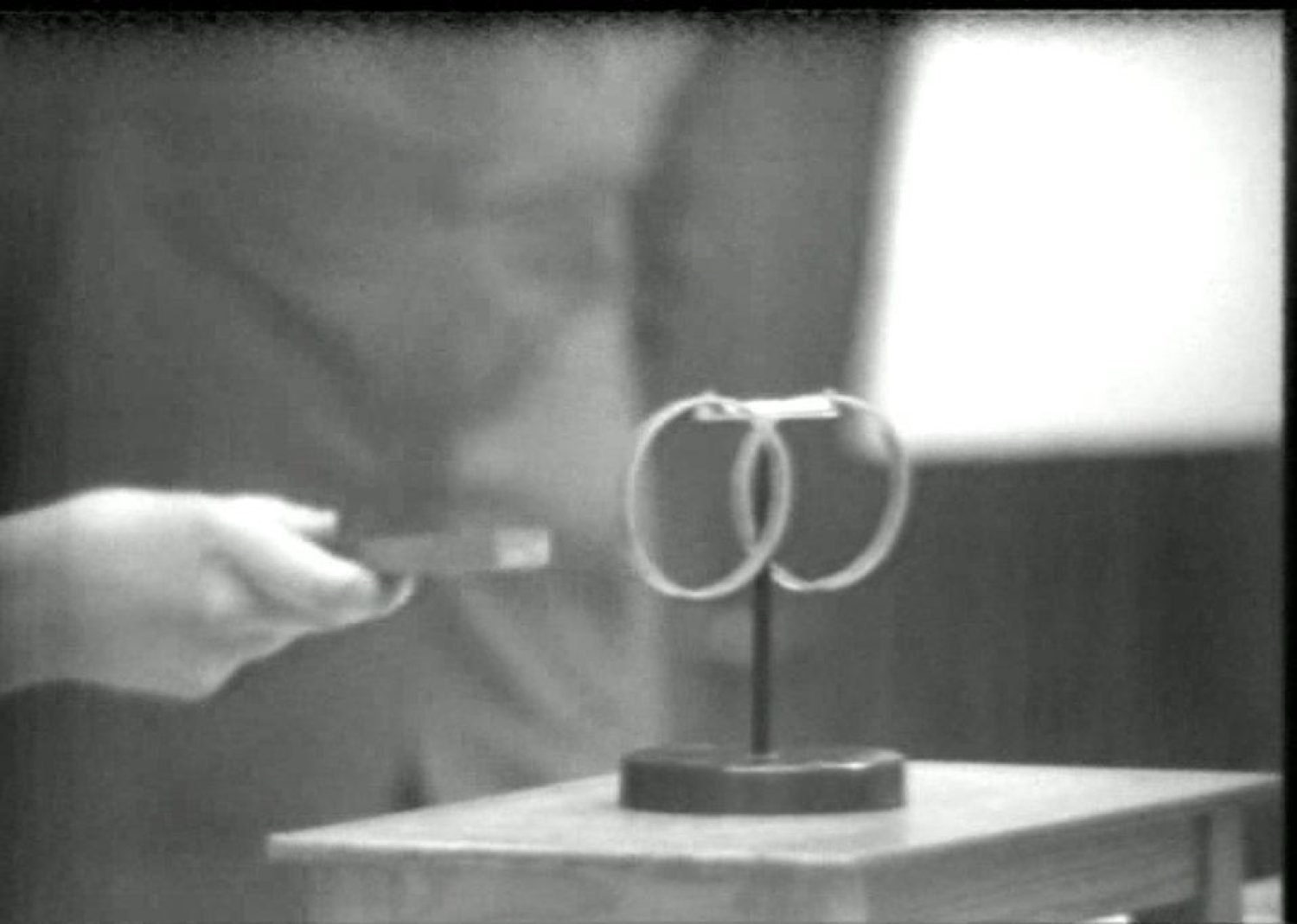
The motif of scientific orientation had already been incorporated into fundamental ideas and objectives of teaching long before 1989. During the early development of the GDR's education system (→ the people's education system), the principle of teaching on a scientific basis and its systematic character was formalised as a didactic principle of the German democratic school through ministerial regulations (Ministry for Education, Volksbildungsministerium,MfV, 1950; → basic didactical principles). In teacher training, the discourse on scientific orientation primarily concerned the quality and legitimacy of content, focusing mainly on the systematic organisation of subject matter. In the 1950s, the principle of scientific orientation served as a counterpoint to folkloric (völkstümlich) content, ideas of education for the common people, and still popular methods from the Weimar Republic’s progressive education movement (Reformpädagogik). For the next few decades, this principle shaped the programmatic approach to general education (MfV 1950, p. 5).
In the 1970s and 1980s, teaching sessions at universities and colleges in the GDR were extensively filmed in order to use the resulting recordings in teacher training and further development (cf. Schluß & Jehle, 2013). This audiovisual material specifically documents the efforts to make teaching scientific. The footage reveals how the concept was understood and how scientific rigor was staged by pedagogical actors both in front of and behind the camera.
Recordings of physics lessons in East Berlin schools during the 1970s highlight how challenging content and didactic requirements were addressed and often considered problematic based on contextual materials and eyewitness accounts. The recordings focus on teachers who heavily structured classroom discussions and content delivery. Simultaneously, student experiments and question-answer sequences, with an emphasis on precise factual relevance, formed a core component of the lessons. The recordings show a recurring, stereotyped didactic-methodical approach: classroom discussions first serve to analyse and explain experimentally demonstrated physical phenomena and then proceed step by step towards the so-called generalisation of findings.
Scientific orientation as a scientifically guided teaching practice
Internal discussions conducted in leading pedagogical institutions from the 1970s onwards increasingly prioritised not only systematic scientific standards for content and organisation but also the successful transfer of knowledge and skills. Assessments of performance in experimental schools (Versuchsschulen) revealed emerging concerns, often expressed through changing objectives for socialist education and its teaching practices. To achieve the productivity desired within the national economy and to address the shortage of skilled labour, there was a growing emphasis on practical applicability and creativity (Schöpfertum), which required a greater focus on life relevance or connectedness to life. The need for scientific precision while paying greater attention to subject relevance and age appropriateness was highlighted (Academy of Pedagogical Sciences, Akademie der Pädagogischen Wissenschaften, APW, 1979, p. 22). This shift brought teacher training and professional development into focus within centralised education policies. Specific problem areas in subject-specific and general didactics were to be addressed in a vivid and modern way (→ subject teaching methodologies). This is evident in audiovisual recordings that are framed by didactic discussions and depict a subject-oriented teacher who maintained a clear focus on students. The programme shown here was repeatedly broadcasted on GDR television as part of the series "By educators for educators".
Scientific orientation and partisanship in teaching
Scientific orientation included alignment (→ partisanship) with the Marxist-Leninist worldview (→ Marxism-Leninism), which formed the state doctrine of the GDR. As a result, science, the claim to truth, and adherence to the resolutions of the Socialist Unity Party of Germany (Sozialistische Einheitspartei Deutschlands, SED) often merged without being fundamentally questioned in the classroom. The subject-specific and general didactic guidelines hindered the discussion of ambiguities and contradictions in school subjects dealing with cultural expressions and their interpretations or with historical and socio-political phenomena. This was particularly true for German lessons.
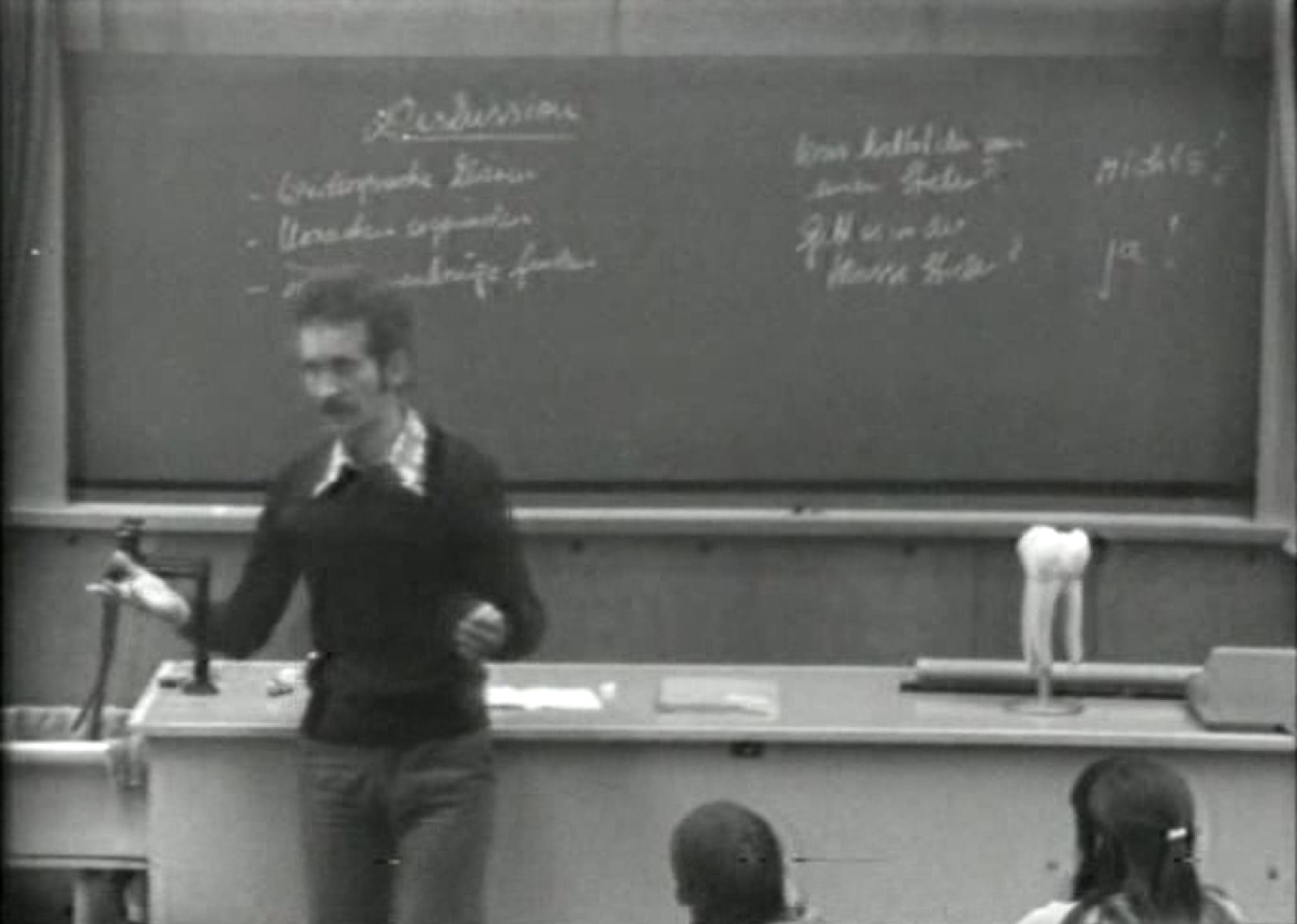
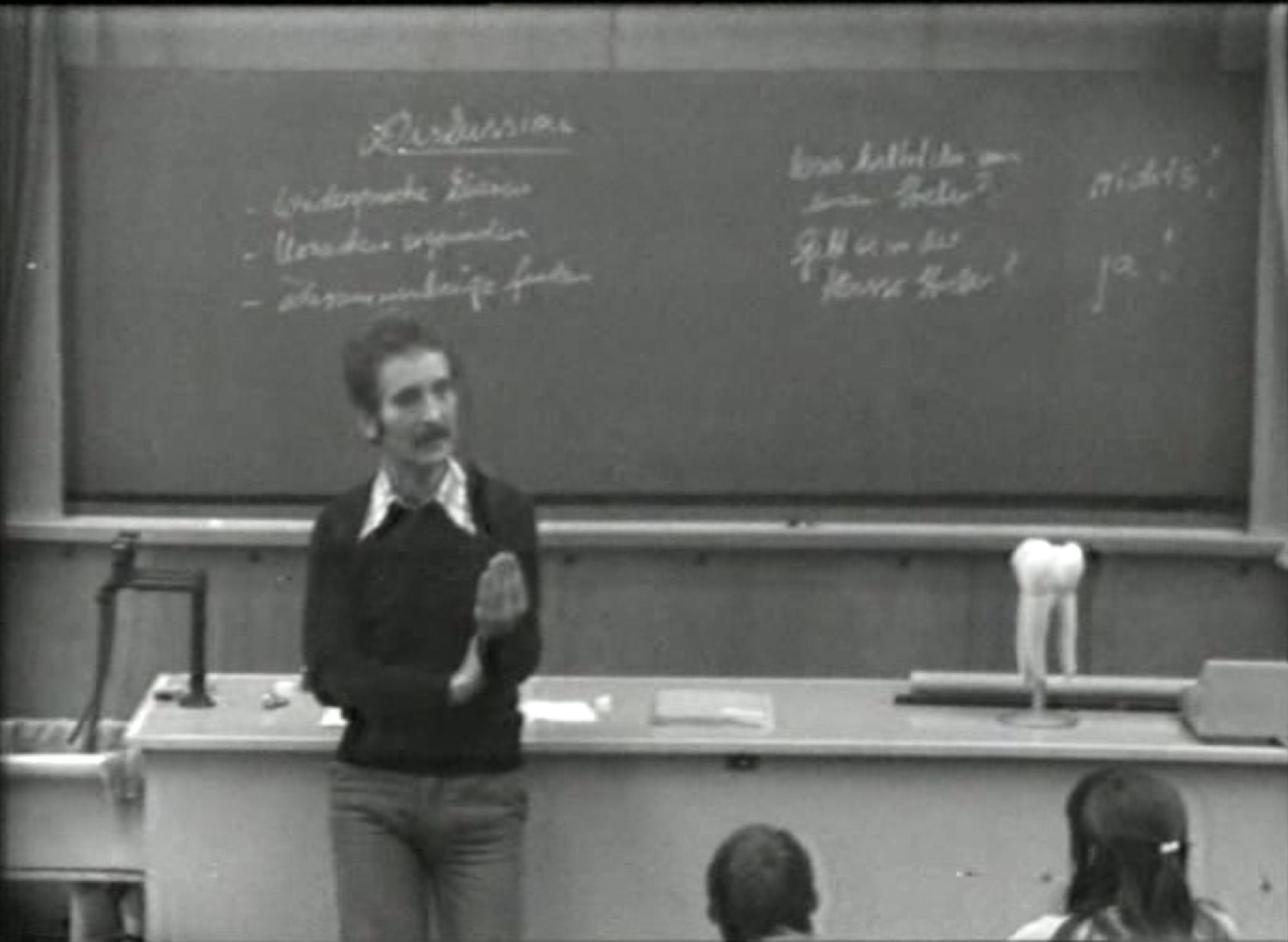
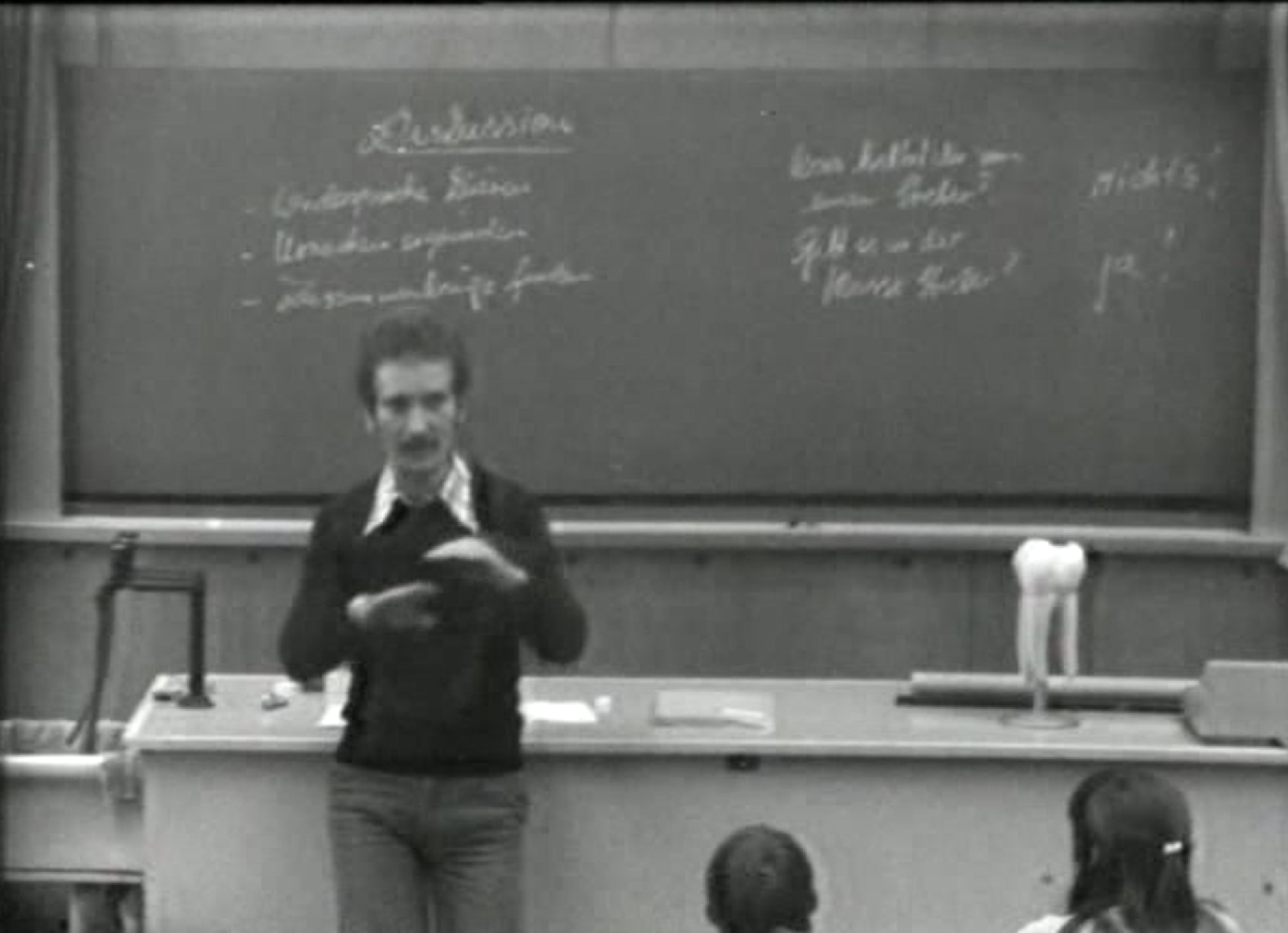
This is evident in video recordings of lessons in first language learning and German literature from the 1970s, where argumentation strategies and processes of forming judgements were the focus of the recording – whether in discussions about proper debating skills or the defining characteristics of revolutionary, combative poetry. It was striking how the frequent use of the term "facts" in classroom discussions created a strong guiding effect. The stills above depict a teacher who was filmed teaching both first language learning and German literature. Through communicative methods and precise gestures, the teacher highlights the reliable learning content based on traditional subject knowledge from linguistics and literary studies, as well as teaching conventions. At the same time, the teacher presents personal experiences and Marxist-Leninist interpretations of poems, historical events, and socio-economic contexts as factual. These facts are found to be ‘good’ and are ascribed the power to support a socialist, revolutionary worldview in arguments.
Such representations create complex images of a fact-oriented teacher who not only masters the subject matter but also emotionally engages with it, albeit clearly structuring his teaching sequences. These images could be used to support the narrative of teaching as both objectively and politically aligned with scientific principles.
The discourse on scientific teaching in the GDR has a long history, in which the motif of science with a claim to truth was used to legitimise content and practices as well as to provide moral guidance. This was especially true for subjects that were strongly socio-political or ideological (→ ideology) in nature. Examining this history highlights the challenges faced by students and teachers in the GDR, as well as during the so-called transition and post-transition period (→ transition / transformation). At the same time, it becomes clear that a simple juxtaposition of scientific orientation and political alignment itself perpetuates a mythologising narrative, failing to account for the historically intertwined relationship between knowledge and power.
-
Akademie der Pädagogischen Wissenschaften (Hrsg.) (1979): Vervollkommnung und Weiterentwicklung des Volksbildungswesens in den achtziger Jahren. Grundmaterial II, Bd. 2. Berlin: Ders.
-
Ash, T. G. (1997): Wissenschaft, Politik und Modernität in der DDR – Ansätze zu einer Neubetrachtung. In: Weisemann,K./ Kröner, P./ Toellner, R. (Hrsg.): Wissenschaft und Politik – Genetik und Humangenetik in der DDR (1949 – 1989). Münster: LIT, S. 1–25.
-
Caruso, M. & Reh, S. (2021): Unterricht. In: Kluchert, G./ Horn, K.-P./ Groppe, C./ Caruso, M. (Hrsg.): Historische Bildungsforschung. Konzepte – Methoden – Forschungsfelder. Bad Heilbrunn: Klinkhardt, S. 255–266.
-
Daston, L. & Galison, P. (2007): Objektivität. Frankfurt a.M.: Suhrkamp.
-
Gruner, P. (Hrsg.) (1990): Angepaßt oder Mündig. Briefe an Christa Wolf im Herbst 1989. Berlin: Volk und Wissen.
-
Malotki, C. v. & Reh, S. (2023): „Wissenschaftlichkeit“ des Unterrichts in der DDR. Motive und Inszenierungen in Filmaufzeichnungen aus dem Deutschunterricht der 1970er und 1980er Jahre. In: Zeitschrift für Pädagogik, Beiheft 69, S. 56–74.
-
Ministerium für Volksbildung (Hrsg.) (1950): Verordnung über die Unterrichtsstunde als Grundform der Schularbeit, die Vorbereitung, Organisation und Durchführung der Unterrichtsstunde und die Kontrolle und Beurteilung der Kenntnisse der Schüler. Berlin: Ders.
-
Molitor, A. (2009): Harte Schule. In: Neuland – Region Dresden, Brandeins Wirtschaftsmagazin 3, 5, S. 32–43.
-
NTV – Nachrichtenfernsehen (2004): Einheitsschule – „Schule in der DDR war besser“. (Abruf 01.05.2016: http://www.n-tv.de/archiv/Schu...).
-
Schluß, H. & Jehle, M. (2013): Videodokumentationen von Unterricht. Zugänge zu einer neuen Quellengattung der Unterrichtsforschung. Wiesbaden: Springer VS.
-
Spiewak, M. (2013): „Ost-Lehrer sind besser“. In: Zeit Online. (Abruf 01.11.2022: https://www.zeit.de/gesellscha...).
-
Wolf, C. (1989): Es tut weh zu wissen. In: Wochenpost 36, 47, S. 3.
-
Wolf, C. (2021): Das haben wir nicht gelernt! In: Hilzinger, S. (Hrsg.): Sämtliche Essays und Reden, Band 2: Wider den Schlaf der Vernunft (1981-1990). Berlin: Suhrkamp.
The first 10 minutes of a television report with the...

The teacher Dr. Tenner giving a German lesson…

Photographs of the pedagogical laboratory...

Letters to the editor in reaction to Christa Wolf's essays...

A central myth within the GDR's socialist conceptions of society was the realisation of an 'education for all' (Bildung für Alle).

The narrative of gender equality was an important element of the state’s self-image in the GDR and the promises of socialism.

The myth of a so-called antifascist founding was part of the GDR's self-image in its use as a system-reinforcing narrative.

Groups such as the class at school or the Young Pioneers (Junge Pioniere) and the FDJ (Freie Deutsche Jugend) played an important role in the GDR as 'collectives'.

Children in the GDR were educated by way of becoming socialist personalities. How do contemporary witnesses describe their GDR childhoods?
