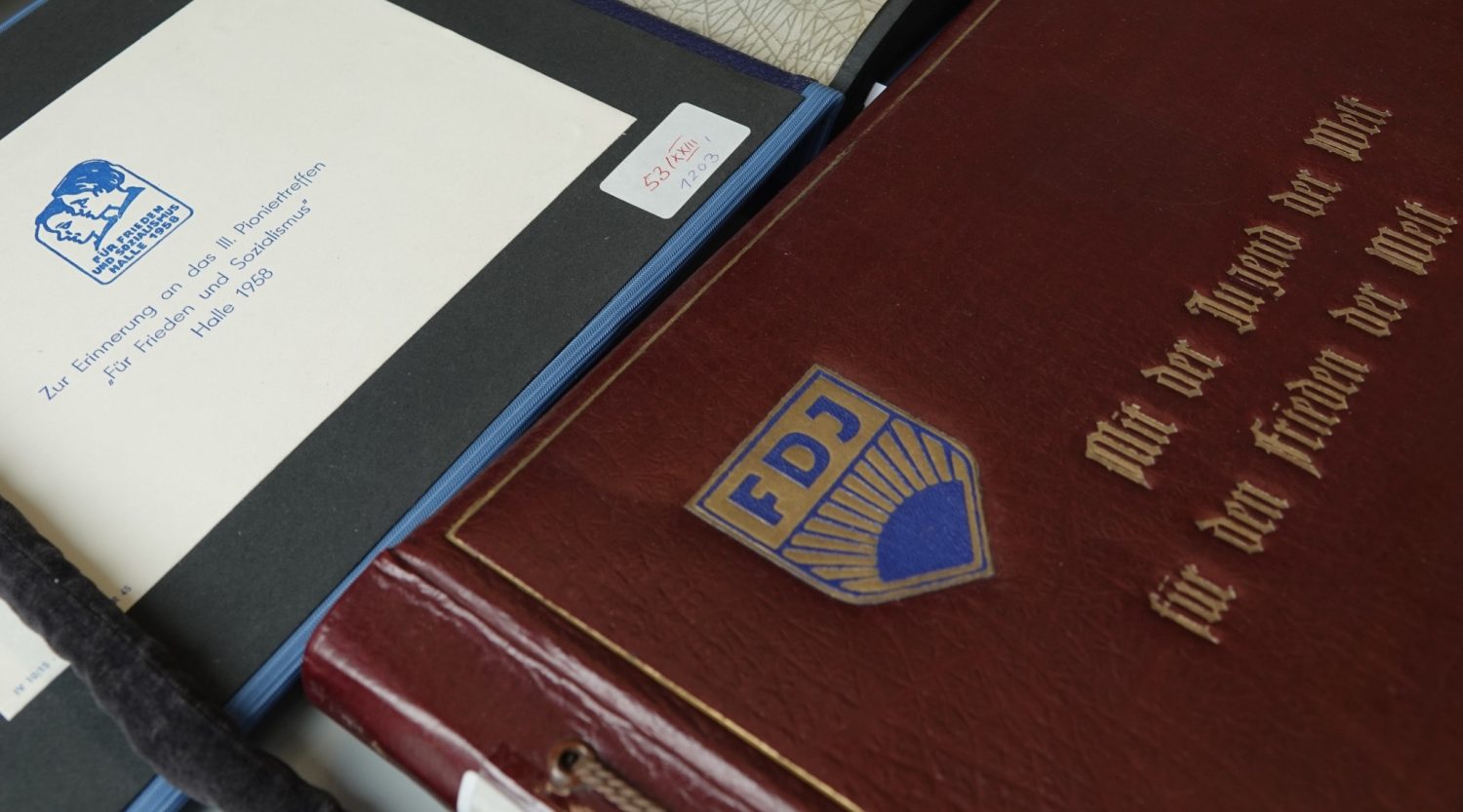
The Pioneer organisation in the GDR belonged to the youth organisation Free German Youth (FDJ) and its “highest priority” was "political-ideological education" (Kaiser, 2022, p.191). Structurally, the Pioneers were affiliated with schools, so everyday school life was closely linked to Pioneer organisational structure. This close connection between Pioneers and school is also reflected in accounts of memories (→ memory) by contemporary witnesses in conversations with today's primary school children conducted as part of a case study on childhood memories. They usually address the topic of Pioneers in the context of school. The focus is on descriptions of external appearances and organisational processes.
This becomes clear, for example, in this quote from one of the conversations with Mr Alder1 (geboren 1965):
"When you started school, you became a Young Pioneer. There were Pioneer neckerchiefs. Right? And these white shirts. On the side you had a Pioneer emblem. And in fourth grade you became a Thälmann Pioneer, then you got a red neckerchief. You didn't have to wear it every day, but there were days when, for example, there was a flag ceremony. [...] Then everyone lined up in front of the school in a sort of 'U', in a U-shape. And then they told us what was happening and when there were sports days, everything was announced."
In his account, starting school meant joining the Pioneer organisation. This account is typical of the memories recounted in the interviews between older people from the GDR and today's primary school children. All the children were Pioneers during their school days - children who were not members are not discussed. His description of the Pioneers is also found similarly in other interviews: they are described in particular with regard to the blue neck scarves, but the other pieces of clothing in the Pioneer uniform are also taken up by the contemporary witnesses. The memories recounted thus mainly consist of descriptions of externals. Mr Alder describes the flag ceremony in terms of organisational procedures. This account also recurs repeatedly throughout the interviews conducted.
In conversations2 with Ms Hornbeam (born 1967), Ms Willow (born 1969), Ms Datepalm (born 1965) and Ms Linden (born 1943), provide examples of the accounts about the Pioneers that recur in the conversations between contemporary witnesses and today’s primary school children. Ms Hornbeam initially addresses the Pioneers directly in connection with questions about her life. She makes clear the connection between Pioneer organisation and the institution of school. At the same time, her language - she switches from the active "I" to the more passive "one" - shows that participation in the Pioneer Organisation seems to have been a passive act for her. She also directly mentions the blue neckerchief and the Pioneer membership card:
"[…] at school you became a Young Pioneer in the first grade. That means you got a blue neckerchief and a Pioneer membership card. And it contained the ten commandments for the Pioneers, how they had to behave. So always, always be polite and always helpful and so on, that’s how you got a Pioneer membership card."
In further descriptions, Ms Hornbeam gives details about clothing and talks about pioneer afternoons as leisure activity. Finally, she addresses the flag ceremony as a school assembly and describes how it was carried out:
"Then you had to stand in the schoolyard, each grade individually. Then the headmistress stood in the middle, or the headmaster, and with the class representative [...]. He then went forward and announced that the class is now quiet and listening."
Ms Willow is asked directly by the interviewing child about being a Thälmann Pioneer. She describes them as a club at school:
"Well, in the GDR, it was that, when you went to school, you were in school, but at the same time there was also, maybe something a bit similar to today’s sport club, there was always a parallel club. They were the Young Pioneers."
As the conversation continues, she also describes the clothing mentioning the neck scarves, the Pioneer blouses and the caps. She also assigns the Young Pioneers and the Thälmann Pioneers to respective grades. Wearing Pioneer clothing was determined by the teacher and was a must on certain political holidays and special school days. Ms Willow “can't really remember” what they did exactly as Pioneers, but she does remember the membership fees that were collected for festivals and prizes for virtuous behaviour.
Like the other contemporary witnesses, Ms Datepalm places the Young Pioneers in the contact of school. She refers directly to the normality of Pioneer membership in the GDR and recalls the symbolic neck scarves. She then takes up the activity of collecting recyclables and locates it in a context of the common good-oriented, but also politically coloured context: the collection of donations for a country that is at war. In addition to the common good, the focus is also on the community, which is shown, for example, by the personal pronoun “we” used by her throughout her account. She details the joint gathering and celebrations in her year group:
"It was one of those organisations where the children did things for social causes, as we would call it today. I don't know, we had cake sales and then donated the money to, for example, the Vietnam war was still going on back then, right? We collected money for the children in Vietnam. Or there were also these scrap materials, for example, if you had a pickle jar or something like that, right? Or a wine bottle or a tomato ketchup bottle. We could take all of that to the scrap dealer and get money for it."
Unlike Ms Hornbeam and Ms Willow, Ms Datepalm places the Pioneer afternoons in an ideological context (→ ideology) : the social order was “instilled” in children. Here she draws parallels to the present and compares pioneer afternoons with politics lessons today. Other afternoons, however, according to her account, were about celebrating and being together. Ultimately, she concludes, in line with her opening, that the Pioneer organisation can be characterised primarily by social projects.
Ms Linden is part of an older generation than the other case studies and spent her childhood in the early days of the GDR. Nevertheless, her recounted memories differ only slightly from the others. She also broaches the issue of the neck scarves at first and describes the Pioneers as a leisure activity that was linked to school. She also speaks of specialist “working groups“. Her own experiences as a Pioneer remain positive in her memory. At the same time, unlike Ms Hornbeam, Ms Willow and Ms Datepalm, she speaks much more critically of the Pioneers. Ms Linden describes herself as a religious child who initially accepted the facts uncritically and only questioned them critically from early adolescence onwards (→ youth and youth culture). Ms Linden also positions herself as oppositional and says that she was not a member of the FDJ as a teenager and therefore had “problems“, without elaborating on this further:
"And so, I was still a believer (laughs) as a Pioneer. And then when I was about the same age as you are now [Editor's note: 12 years old], I started to think about it, right? Like, whether it was actually any good and whether it was right and so on. And then I stopped taking part and didn't join the FDJ like people expected. And then I started having problems."
The recounted memories presented here are predominantly descriptions of external things. In addition to clothing, the contemporary witnesses also talk about leisure activities, working groups, and the collection of recyclables. The Pioneers appear apolitical in almost all of the accounts given by the contemporary witnesses interviewed. Two cases are particularly noteworthy here, unlike the other contemporary witnesses, that classify the Pioneers as political indoctrination: Ms Datepalm and Ms Linden. In contrast to them, for example, Ms Hornbeam stands out. She does address the Pioneer’s ten commandments, but focuses on virtues (politeness, punctuality).
Overall, the contemporary witnesses accounts appear stereotypical, for example in the description of Pioneer symbols such as the neckerchief, and of rituals such as the flag ceremonies, which appear repeatedly in recounted memories. Interestingly, these narratives are also found in other studies: Kaiser (2022, p. 196), for example, emphasises that the three recurring stereotypes in the recounted childhood memories of Pioneer times are scrap material collection, flag ceremonies, and the neckerchief.
-
[1]
All names are pseudonyms. The interviews were conducted and transcribed in German and later translated into English.
-
[2]
In the following excerpts, the I. stands for the child doing the interview, the B. for the student assistant. Other letters stand for the pseudonyms of the contemporary witnesses being interviewed.
-
Kaiser, B. (2022): Erziehungs- und Bildungsverhältnisse in der DDR. Bad Heilbrunn: Klinkhardt.
-
Peuke, J./ Pech, D./ Urban, J. (2021): Etwas mitgeben – Gespräche zwischen Grundschulkindern und älteren Menschen aus der DDR. In: Zeitschrift für Didaktik der Gesellschaftswissenschaften 2, S. 141–159. (Abruf 24.05.2024: https://www.fachportal-paedago...).