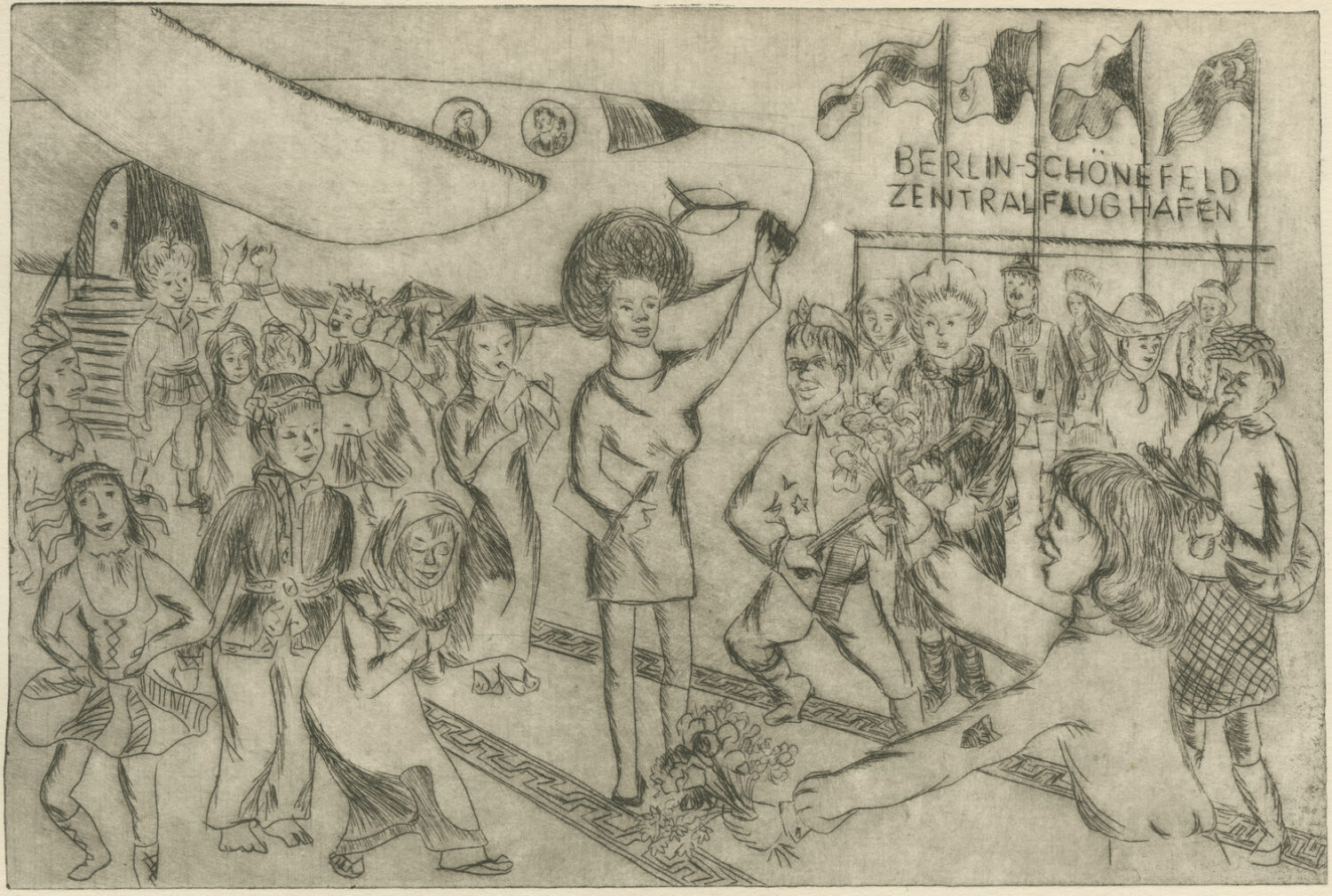
The GDR's foreign policy was characterised by Marxist-Leninist principles (→ Marxism-Leninism). Its declared goal was ‘international solidarity‘ with all socialist countries and movements. While the early days of the GDR were primarily concerned with "working-class solidarity", from the 1960s onward, the focus shifted to a global, universalistic duty to stand up against imperialism and its colonial regime, for national freedom and independence (Article 6 of the Constitution, quoted in Bösch, 2018, p. 11).
The GDR trained apprentices and students from countries such as Vietnam, Angola, Chile, and Cuba, provided reconstruction aid in the Global South, collected donations, signed petitions for victims of persecution, e. g. African Americans, fought against Apartheid, and shipped military supplies to selected countries. These various efforts, which can be summarised under the term of ‘international solidarity‘, served not only to provide unrestricted aid to foreign countries but also to strengthen the GDR's external and domestic legitimacy. Until 1973, the GDR was not recognised as an independent state by the government of the Federal Republic of Germany (FRG), so it sought to gain international recognition by other means. It was only with the amendment of the basic treaty (Grundlagenvertrag) on December 21, 1972, which was ratified by the FRG on May 11, 1973, and by the GDR on June 13, 1973, and took effect on June 21, 1973, that the FRG and the GDR were able to join the United Nations on September 18, 1973 (see Deutscher Bundestag, 2023). From then on, the GDR was recognised as a sovereign state. Even after this recognition, the GDR government continued to promote efforts toward ‘international solidarity‘ with all ‘socialist brother states‘ and movements. All citizens of the GDR were expected to participate in this: children, young people, and adults.
The following section presents accounts from people who grew up in the GDR on the topic of ‘international solidarity’. The interview excerpts are taken from the study "Childhood in the GDR," in which 50 biographical-narrative interviews were conducted between 2020 and 2021. The interviewees were born between 1943 and 1973. The interviews focused on memories of childhood and adolescence ( → youth and youth culture) in the GDR. Some of the interviewees recalled specific experiences related to an upbringing focused on ‘international solidarity’.
Gerd Schulz1 (born 1948) addresses the GDR's alignment with the Soviet Union. He recounts a pen pal friendship with a girl from the USSR:
"She lived [...] by the Caspian Sea (I: Yes) and yes, she always sent me lovely letters. Oh, they had a scent, with some kind of badges, and they already had red pioneer neckerchiefs (I: Aha) made of silk (I: Aha) and we always wrote to each other It was all viewed with benevolence, yes (laughs), supported with benevolence, right?"
Due to the close relationship with the Soviet Union, pupils in the GDR learned Russian as their first foreign language from the fifth grade onwards at the latest. Pen pal friendships were arranged through the Society for German Soviet Friendship (Gesellschaft für Deutsch-Sowjetische Freundschaft, DSF). In addition, various measures and events were organised to introduce the people of the GDR to Soviet culture and society. Many of those who grew up in the GDR still remember, for example, their pen pal friendship with (at least) one child in the USSR. Gerd Schulz, who corresponded with a girl from the Caspian Sea for several year, is one of them. He received photographs and small gifts from the girl along with her letters, and gained insights into life in the Soviet Union. Looking back, he views the pen pal friendship as gentle guidance from the state, as it was "viewed with benevolence " and "benevolently supported " – as Gerd Schulz sees it, children were to be brought up to be friends with their ‘big brother’
Torsten Bergner (born 1965) remembers that his brother (born 1968) was taught to embrace ‘international solidarity’ as a kindergarten child. He says:
"So my brother [...], also went to a state-run kindergarten [...] and then in this state-run kindergarten, I still remember it like it was yesterday, [...] then they had to, um – my parents always got incredibly upset about it (laughs) – and then they had to stick these solidarity stamps for Luis Corvalán, [.] a Chilean communist, uh, who had been imprisoned there under Pinochet, they had to – solidarity stamps were made, had to be stuck on, uh, they had to write protest letters for the release of Angela Davis, that was the woman's name, she was an American civil rights activist, a communist. All that kind of stuff. I didn't have to do anything like that at my kindergarten (I: Mhm), yes. So that-, that was really alienating to me, right? (I: Mhm) So that-, because of course I didn't know that. I really had a classic kindergarten career in a Protestant kindergarten, right?"
According to Torsten Bergner, children in state-run kindergartens were expected to stick solidarity stamps and write letters of protest on behalf of famous communists and civil rights activists. Torsten Bergner recalls two important figures important in the context of ‘international solidarity’: Luis Corvalán and Angela Davis, to whom the children were expected to show solidarity.
Luis Corvalán was a Chilean politician who was arrested and sent to a concentration camp following Pinochet's military coup on September 11, 1973. Until then, he had been secretary general of the Chilean communist party and, as part of Unidad Popular, a member of Salvador Allende’s government. Among other things, Chilean communists received funds from the Central Committee (Zentralkomittee) of the SED, and Allende's government received economic and technical aid from the GDR. A trade agreement between the GDR and Chile had already been concluded in 1971. Chilean socialists and communists also received ideological (→ ideology) and military training in the GDR (cf. Dufner, 2013, pp. 527ff.). In November 1972, Corvalán visited the GDR to meet with Erich Honecker. As a result, starting in 1973, so-called solidarity deliveries (Solidaritätslieferungen) were sent from the GDR to Chile. After the military coup in September 1973, contact with Santiago de Chile was broken off; however, trade relations continued (cf. ibid., pp. 540ff.).
The 'solidarity' with Corvalán addressed by Bergner and the desired 'expressions of solidarity' represent the cooperation between the GDR and Chile's communist and socialist groups. The solidarity stamps collected at the kindergarten for Luis Corvalán were intended to be a small contribution to this cooperation.
Angela Davis, the second person mentioned in Torsten Bergner's interview, was an African American civil rights activist and an important member of the Black Power movement. She visited the GDR for a week in November 1972. Prior to her visit, solidarity campaigns were organised in the GDR from November 1970 to June 1972. Countless solidarity postcards, petitions, and resolutions were written, and various events were held. Within the GDR, Davis was celebrated as an "ally in the fight against racism and inequality," as a "heroine of the other America," and declared a role model – especially for the youth of the GDR (→ youth and youth culture). With "her continuous expressions of support for the GDR […], she contributed more than any other representative of the 'other America' to ensuring that international solidarity functioned as a political-ideological and social source of meaning in the GDR, thus shaping the interpretation of the world and reality in the GDR – at least temporarily" . This served the GDR’s internal and external self-legitimisation (Lorenz, 2018, pp. 211, 234).
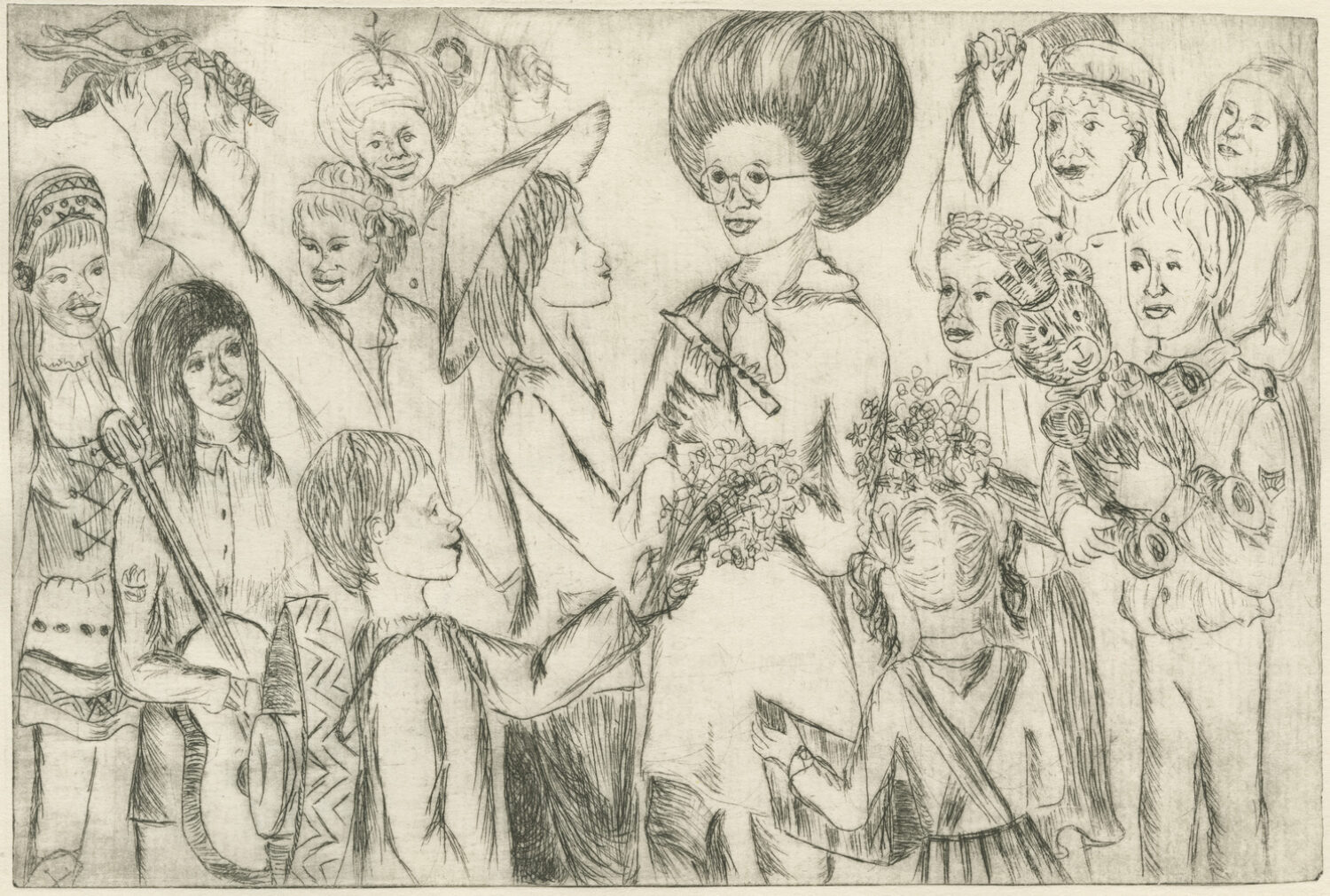
In the interview, Torsten Bergner expresses his irritation with the expressions of solidarity (Solidaritätsbekundungen) in his brother's state-run kindergarten. This irritation can also be understood as a defence against early political indoctrination in opposition to the class enemy (Klassenfeind). As a person with Christian upbringing, he positions himself as someone who views early state socialisation critically. He distances himself from political education at kindergarten age and prefers kindergarten education and training void of political indoctrination.
André Schleser (born 1970) also recalls early political influences. His account is focused on the socialisation within the Pioneer Organisation (→ Pioneers, see also Sources in focus: Pioneer narratives) and he says:
"I think the Young Pioneers (Jungpioniere) were left alone for the most part. There were the statutes, that is, this little booklet (I: Yes), which explained what characterises a Young Pioneer or how a Young Pioneer should behave (I: Yes), like being helpful, being punctual, and serving peace (I: Yes). I don't even know what was in there, but um, people lived according to the statutes, but they actually did relatively little agitation with these young people (I: Yes). At least that was the case at my school, yes, we were basically left alone, and then things got more intense, in fourth grade, with preparation for the Thälmann Pioneers (Thälmannpioniere)."
André Schleser recounts that while the Young Pioneers were supposed to live according to the "Ten commandments of the Young Pioneers" („10 Gebote der Jungpioniere"), political instruction in the spirit of socialism, at least at his school, only really began in the fourth grade with the preparation for the Thälmann Pioneers, who were expected to live according to the "Laws of the Thälmann Pioneers" („Gesetze der Thälmannpioniere", cf. mdr, 2023).
According to André Schleser's recollections, children were provided with political training through discussion of political topics during pioneer afternoons (Pioniernachmittage):
“We actually met for pioneer afternoons (I: Yes) and discussed political topics together with the class teacher or just in class (I: Yes) and you have to say '76, '77 or even '79 , it was already the end of the '70s, I can remember, for example, that we talked a lot about Chile, about Vietnam (I: Mhm), about the class struggle (Klassenkampf) of socialism (I: Yes) and how other people felt and there was a lot of talk and discussion about it and well, not that much discussion, but more talking about it and if you then said, "well, you have to see it from the other perspective" or something like that (I: Mh), then you were silenced pretty quickly (I: Aha) and of course, you didn't want that. Yes. (I: Mhm). Either by the teachers, but the teachers of course welcomed it more when it also came from the pupils (I: Yes). And then there were very, yes, the pupils who were the strongest and who were politically convinced, they were also the ones in the corresponding positions (I: Mhm), they were the Pioneer leaders or the class representatives (Klassensprecher) at the council, and it was relatively difficult to go against them (I: Mhm)."
In the training courses , the pupils were educated, e. g., in the spirit of ‘international solidarity’. The Young Pioneers' commandments stated, among other things, "We Young Pioneers maintain friendship with children of the Soviet Union and all countries", and the Thälmann Pioneers' law stated: "We Thälmann Pioneers are friends of the Soviet Union and all socialist brother nations and maintain friendship with all children of the world". Accordingly, solidarity with the people of brother countries, such as Vietnam, Mozambique, Chile, or Cuba, was to be displayed. As Schleser explains, dissent was not tolerated. According to his recollections, those who were "politically committed" were primarily promoted. They were given key positions as "pioneer leaders" or "class representatives". They were then also the ones who, alongside the teachers, conveyed the state's guidelines to their classmates. The persuasion to adopt a positive attitude toward their "brothers" and "sisters" abroad was conveyed to the children in an emotional way. The children were to experience "how other peoples feel".
As Schleser goes on to say a poster hanging in the art classroom was particularly memorable to him:
"I can also remember, for example, in our art class, I think, from my school days, from '76 until the end, there was a poster hanging there with a little Vietnamese girl, maybe 12; 11 or 12 years old, carrying a toddler or a baby on her back in a sling (I: Mhm), and people were supposed to donate to Vietnam. So it was a call for donations, more like a poster, and it was hanging there – I don't know if she was also carrying a Kalashnikov, to be honest, I’m not sure (I: Yes). I wouldn't be surprised either – and there was a bank account number on it, and you were supposed to donate, yes. And those were the things that were discussed a lot."
Schleser recalls a poster calling for donations for Vietnam. He apparently cannot recall the exact content. It may have shown the famous photo of nine-year-old Kim Phuc, who fled naked with her brothers and cousins, from a napalm attack in 1972 (vgl. Associated Press,1972).2 However, it may also have been a poster by Thomas Billhardt, who called for donations in his solidarity campaigns on behalf of the FDJ (see Billhardt, 2022). Schleser recalls the poster depicting a Vietnamese girl with a baby on her back. He imagines that the girl may have been carrying a Kalashnikov. The weapon was used by the Viet Cong and the North Vietnamese Army in the war against the Americans (see Müller, 2008, p. 153). Billhardt also took a photo of a young Vietnamese woman holding a Kalashnikov. This photo shows a captured American soldier from the Vietnam War being led away by a Vietnamese woman along a riverbed (see Billhardt, 2022). Solidarity was thus propagated with the Vietnamese guerrilla fighters and the army of the still socialist Republic of Vietnam, which was fighting against America. It seems as if several photographs, posters, and 'calls for solidarity' (Solidaritätsaufrufe) had been combined into one poster by Schleser. It is a kind of mental collage that flashes into his memory. It is a remembered poster that calls for emotional sympathy and donations for the people of Vietnam who had been ravaged by 'imperialism' (Bösch, 2018, S. 14).
It is clear from the memories of all three interviewees that in the GDR, even children were encouraged to inform themselves about the 'injustice' of imperialism in the spirit of 'international solidarity' and to stand up for national freedom and independence for socialists in all countries.
-
Associated Press (1972): The Terror of War [Fotografie] (Abruf 08.10.2025: Wayback Machine).
-
Associated Press (2025): Investigating claims around ‘The Terror of War’ photograph (Report). (Abruf 08.10.2025: AP-Terror-of-War-report.pdf).
-
Billhardt, T. (2022): Fotografien von Thomas Billhardt. Vietnam. Berlin: Edition Braus Berlin GmbH.
-
Bösch, F. (2018): Internationale Solidarität im geteilten Deutschland. Konzepte und Praktiken. In: Bösch, F./Moine, C./Senger, S. (Hrsg.): Internationale Solidarität. Globales Engagement in der Bundesrepublik und der DDR. Göttingen: Wallstein Verlag, S. 7-34.
-
Deutscher Bundestag (2023): Kalenderblatt. 11. Mai 1973: Bundestag ratifiziert Grundlagenvertrag mit der DDR. (Abruf 29.09.2025: Deutscher Bundestag - 11. Mai 1973: Bundestag ratifiziert Grundlagenvertrag mit der DDR).
-
Dufner, G. J. (2013): Chile als Partner, Exempel und Prüfstein. Vierteljahresheft für Zeitgeschichte. Bd. 61, Nr. 4, S. 513-548.
-
Lorenz, S. (2018): „Schwarze Schwester Angela“. „Rot-schwarze“ Verbundenheitsvorstellungen und die DDR Solidaritätskampagne für Angela Davis. In: Bösch, F./Moine, C./Senger, S. (Hrsg.): Internationale Solidarität. Globales Engagement in der Bundesrepublik und der DDR. Göttingen: Wallstein Verlag, S. 209-234.
-
mdr (2023): Erziehung im Sozialismus. Gebote, Gesetze und Symbole der Pioniere. (Abruf 19.06.2025: https://www.mdr.de/geschichte/...).
-
Müller, C.T. (2008): Die Kalaschnikow – Geschichte und Symbolik. (Abruf 02.10.2025: https://www.zeithistorische-fo...).